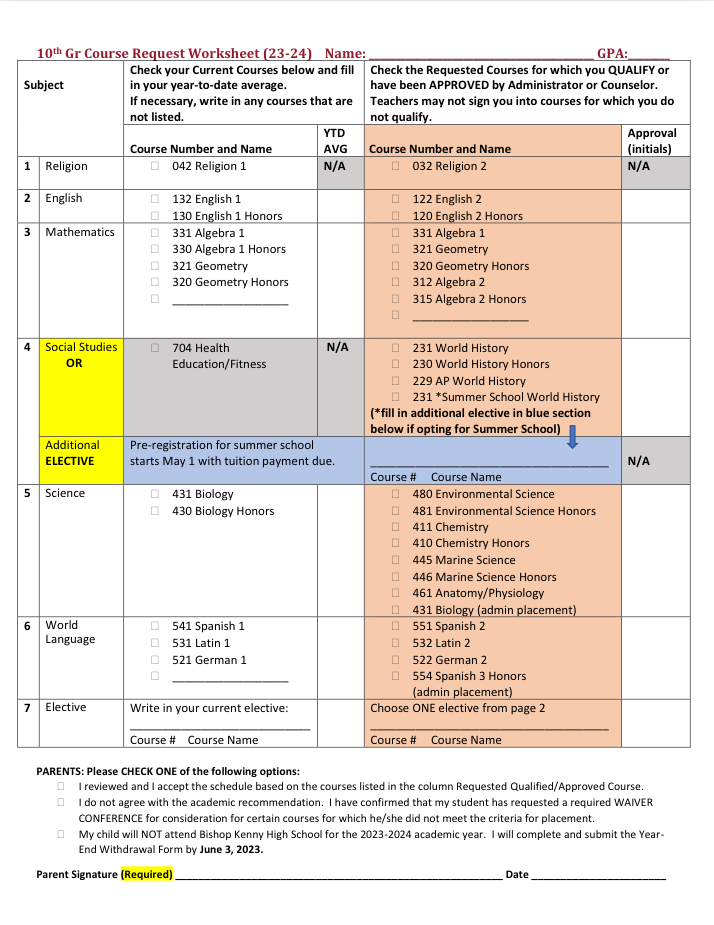
Course Selection sounds simple; it is the process where students choose which courses they wish to enroll in for the following school year.
However, knowing which courses are most suitable and managing the various forms can be complex. The easiest way to navigate this year’s selection process is to approach it thoughtfully. The course selection form is available in each class cohort module, and freshmen, sophomores and juniors will watch a video during Flex mod to explain how to fill out the necessary form.
The first thing you see when filling out the course selections is your year-to-date average (YTD). But what even makes up this number? Your YTD average comprises your quarter 1, quarter 2, quarter 3 and midterm exam grades. Then, you divide this sum by 7 to calculate your YTD average. This number is also shown on FACTS on the Quarter 3 Report Card screen.
If you do not reach the needed average or GPA to be admitted into an upper-level course, then you can request an academic review. Academic Dean Ashleigh Bradley and Assistant Academic Dean Jennifer Whitford review a student’s grades, after-school activities and teacher recommendations to determine if the requested course is really the right fit for your academic career.
What is a good baseline to know if your academic review will be passed?
It is recommended that you are at least 5 points within the point average that is needed. For example, if you are trying to go from English 2 to English 3 Honors, and you have an 87, then it is not recommended that you submit for a review since the required grade to move from college prep to honors is a 95 point average.
What if you get lost in the academic course selection process?
Your first step in this situation is to make an appointment to meet with your school counselor. Ask for their advice. If you are unsure if you want to take a class, you might also consider speaking to the head teacher of the course; ask them about the workload of the course, or anything else that might concern you. Sometimes they can give you advice on whether the course is best structured for you.
Ultimately, if you still have questions then you can always talk to Bradley, Whitford or Vice Principal of Academics Micahel Broach.
How will you gauge your limit the year before, and balance your academics with extracurricular activities?
Sometimes you may be eligible for all the classes with strong academic rigor, but that is when you must take a step back and be completely honest with yourself.
“If you are involved in sports and school life, there is nothing wrong with taking one less AP or honors class,” Whitford said.
Leave room for school activities and, most importantly, protect your mental health.
What happens if you regret your course selection choices?
If you are still in the school year and have not started the courses you selected yet, then it’s not too late to manage changes. Just stop by the Academic Office and they can help you. Schedules are created and finalized during the summer, though, and when the school year begins, changes are no longer permitted. It is important to be thoughtful when selecting classes and making sure that you are correct in your decisions.
What is the most important thing to remember when going through the course selection process?
Honors and AP classes are not a “quick GPA boost.” Rather, they are a full-time commitment, and you have to remember to select classes for the right reasons and focus on a balance in your academic and extracurricular workload.